
Customers Who Bought This Item Also Bought
| EAN/UPC | 5905555011523 |
|---|---|
| Manufacturer | LEVENHUK |
| Manufacturer Code | 69299 |
| Price | €74.95 |
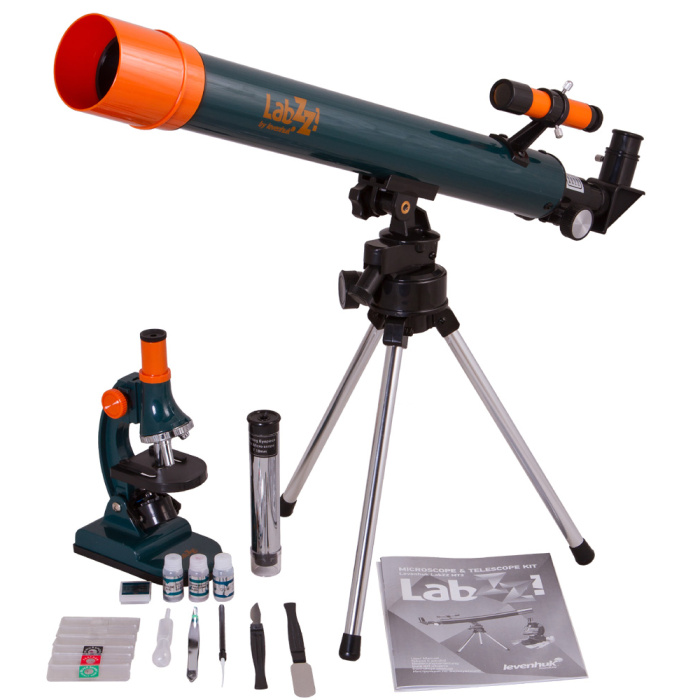
A treasure trove of interesting discoveries awaits your children thanks to the Levenhuk LabZZ MT2 microscope + telescope kit! The kit includes a biological microscope with a set of experiments and a refracting telescope. These practical instruments are characterized by high-quality optics and sturdy structures. The user guide is written with young explorers in mind, featuring simple and easy-to-understand instructions. The kit is designed for children over 6 years old. Levenhuk LabZZ MT2 is also suitable for teenagers who want to have fun exploring the skies and the microscopic world.
A treasure trove of interesting discoveries awaits your children thanks to the Levenhuk LabZZ MT2 microscope + telescope kit! The kit includes a biological microscope with a set of experiments and a refractor telescope. These practical and easy-to-use instruments feature high-quality optics and sturdy constructions. The user guide is written with young explorers in mind, with simple and easy-to-understand instructions. The kit is designed for children over 6 years old. Levenhuk LabZZ MT2 is also suitable for teens who want to have fun exploring the skies and the microscopic world.
Here are the main advantages of this kit:
Telescope
The Levenhuk LabZZ MT2 telescope is a refractor that uses a group of lenses to gather and focus light. Its 50 mm objective lens makes it suitable for both astronomical and terrestrial observations.
The telescope comes with two different eyepieces. The H12.5 mm eyepiece (50x) is used to observe astronomical objects such as the Moon and planets of the Solar System. The 18 mm erecting eyepiece (35x), on the other hand, is designed to display an upright image (not inverted or mirrored) of the observed object, making it practical for terrestrial observations. The erecting eyepiece can also be used as a pocket microscope with a magnification factor of 14x.
The telescope is mounted on an altazimuth mount, easy to use, allowing horizontal and vertical movement of the tube. Additionally, a compact tabletop tripod provides a stable and reliable base for our instrument.
Microscope
The Levenhuk LabZZ MT2 microscope is designed for observing transparent samples. The set includes three objectives with magnifications of 75x, 300x, and 900x. A handy revolving nosepiece allows quick switching between magnifications.
To start, just position a sample on the microscope’s stage located just above the mirror. If the amount of light directed by the mirror is insufficient, the built-in illumination system can be used.
The kit includes everything needed to operate the microscope, along with a wide set of ready-to-use slides and useful tools for preparing new samples.
The kit includes:
Some of the things that can be observed through the Levenhuk LabZZ MT2 microscope:


These prepared slides are included in the Levenhuk LabZZ MT2 kit.
| Brand | LEVENHUK (USA) |
| Warranty, years | lifetime |
| EAN | 5905555011523 |
| Package size (LxWxH), cm | 86x23x10 |
| Shipping weight, kg | 1.688 |
| === Delimiter === | Microscope |
| Type | biological |
| Head | monocular |
| Magnification, x | 75 — 900 |
| Magnification range | from 800x to 1280x |
| Revolving nosepiece | for 3 objectives |
| Illumination | mirror, LED |
| Power supply: batteries/built-in battery | 2 AA batteries (not included) |
| User level | for children |
| Application | children (3-7 years) |
| Illumination position | lower |
| Research method | bright field |
| Experiment kit included | yes |
| === Delimiter === | Telescope |
| Optics design | refractor |
| Objective lens diameter (aperture), mm | 50 |
| Focal length, mm | 500 |
| Eyepieces | H12.5 mm (50x), 18 mm erecting eyepiece (35x) |
| Finder | optical, 2x |
| Tripod | aluminum |
| Mount | altazimuth |
| User level | for children |
| Observed object | terrestrial objects, planets of the Solar System |
Questo sito utilizza cookie per migliorare la tua esperienza. Cliccando su «Rifiuta», acconsenti all'uso esclusivo dei cookie Necessari. Puoi anche accettare solo i cookie selezionati.
Login and Registration Form